

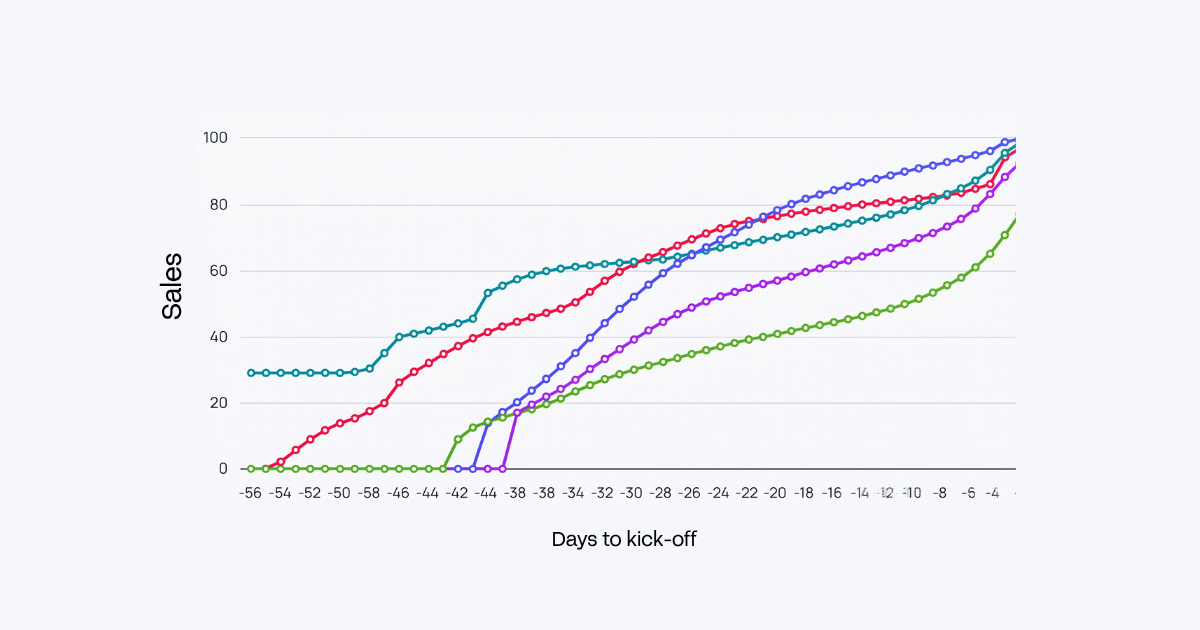
An effective event pricing strategy covers your costs with a healthy margin on top, matches what your audience is willing to pay, and adapts as demand changes. Get it right and you fill the room while growing event revenue. Get it wrong and you either leave money on the table or watch tickets go unsold.
This guide walks through why pricing matters, what shapes it, how to build your own plan, and which pricing models and psychological tactics are worth using.

Why is ticket pricing strategy for events important?
Price is the one lever that touches everything else: revenue, attendance, and how people perceive your event. Set it too high and sales stall. Set it too low and you sell out quickly, but you give up revenue and may signal lower quality than you deliver.
Pricing also shapes decisions across event management, from staffing and cash flow to marketing and inventory, and it works best when it’s planned together with them. Promotion drives the demand your prices depend on, and your capacity release strategy decides how much room you have to react: holding back part of your inventory for later phases lets you raise prices as demand builds, instead of discounting tickets you could have sold at full price with better timing.
In short, a clear pricing strategy replaces guesswork with decisions you can repeat, explain, and improve from one event to the next.

Factors that influence your event's ticket pricing strategy
Before choosing a model, look at the forces that set the boundaries for your prices.
Event format and run length
A one-night concert and a six-month exhibition need very different pricing.
A one-off event has a single sales window, so pricing focuses on building momentum up to one date. An event that runs for weeks or months sells the same experience many times, so you can test prices, learn from early sessions, and adjust for the rest of the run.
Long runs also need to keep demand steady after the opening buzz fades, which makes off-peak pricing and repeat-visit offers more important.
Demand and competition
Start with how much interest your event is likely to generate. A headliner, a limited run, or a well-known brand can support higher prices. A new event with no track record needs to earn its price.
Then look around. Check what similar events in your market charge, and what attendees get for that money. You don't need to match competitors, but you should know where you sit and be able to explain why.
Here are some signals worth paying attention to:
- Comparable events: how many tickets similar events sold, at what prices, and how quickly they sold out.
- Waitlist sign-ups and conversion: how many people register interest before tickets go on sale, and what share of them go on to buy.
- Search and social interest: search volume for the artist, show, or format, and engagement with your announcements on social media.
- Early sales velocity: how fast presale or first-day tickets go, which is the clearest sign of whether your price matches demand.
Venue capacity and location
Capacity sets your ceiling. A 300-seat venue can't rely on volume the way a 30,000-seat arena can, so each ticket has to work harder.
Smaller venues benefit most from premium ticket types, add-ons, and bundles that raise the average spend per attendee, while large ones can use wider price ranges, with accessible entry tickets alongside premium sections.
Location matters too. Events in major cities usually carry higher costs, but also draw audiences with higher spending power and more alternatives to choose from.
Seasonality and timing
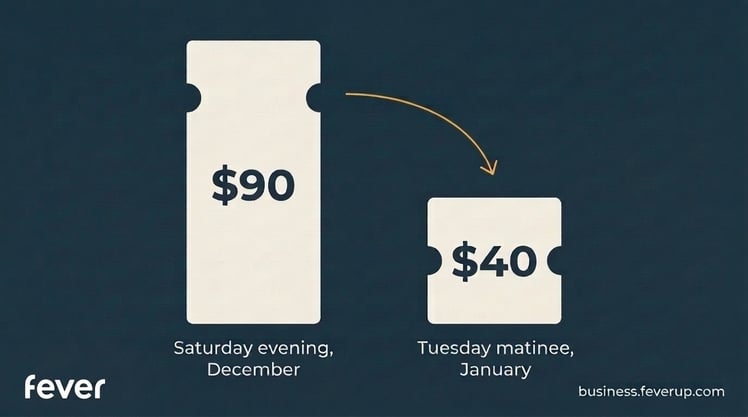
Demand moves with the calendar, and so should your prices. Consider a theater that charges $90 for Saturday evening performances during the December holiday rush, but drops the same seats to $40 for a Tuesday matinee in mid-January to stimulate off-peak demand.
Holidays, school breaks, and peak tourist months tend to lift willingness to pay, while off-peak periods may need sharper pricing or added value to fill seats.
Timing matters at a smaller scale too:
- Day of the week: Friday and Saturday sessions usually sell faster and can carry higher prices than weekday dates.
- Time slot: evening sessions often outsell matinees for adult audiences, while daytime slots work better for families.
- Competing events: a major concert, sports final, or festival in your city on the same date can pull your audience away.
- Weather: for outdoor events, a sunny forecast can lift last-minute demand, while rain can stall it.
If your event runs across multiple dates or time slots, don’t use one flat price for the whole run. Group your sessions into pricing tiers instead. That way, each session carries a price that matches its expected demand, and you can move individual dates between tiers as real sales data comes in.

How to build your event pricing strategy
Define your event's goals
Pricing looks different depending on what you want to achieve. Maximizing profit, selling out, building a loyal audience, or promoting a new brand each require different pricing strategies. Pick your main goal first, and let it guide every other decision.
Understand your event ticket buyer
Not everyone values your event the same way, so don’t price as if they did. Break your audience into segments and ask what each one is willing to pay for:
- Experience seekers want the best seats, early entry, or exclusive access, and will pay a premium for them.
- Price-sensitive buyers, such as students or families, need an accessible entry point and are more likely to respond to discounts or off-peak dates.
- Social buyers come as a group or as a gift and look for packs, group rates, or extras that make the occasion feel special.
To estimate willingness to pay, look at what each segment has bought in the past, which ticket types sold out first, and how they reacted to earlier price changes. If you’re starting from scratch, a short survey or a presale to your most engaged audience can give you an early signal.
Those differences show you where to add premium options, where to keep prices accessible, and where bundles or group pricing can unlock extra revenue.
Calculate your break-even price
Your break-even price is the minimum price you should sell a ticket for to cover your costs. The basic formula is:
Break-even price = (fixed costs / expected tickets sold) + variable cost per attendee
Start with a realistic estimate of how many tickets you can sell, based on your venue capacity, past events, or comparable shows in your area. Say your fixed costs (venue, talent, production) total $20,000, you expect to sell 500 tickets, and each attendee costs you $10 in variable costs (marketing spend per ticket sold, payment fees, wristbands). Your break-even ticket price is $50: $20,000 ÷ 500 = $40 to cover fixed costs, plus $10 per attendee.
Run the numbers for a few attendance scenarios. If you only sell 400 tickets, you’d need to charge $60 to break even; if you sell 800, $35 is enough. Seeing that range tells you how much risk you’re taking on at any price point. Any amount you charge above your break-even price is profit.
Set your price points and event ticket structure
With your goals, audience, and costs clear, set a base price that sits comfortably above your break-even and in line with what similar events charge. Then build around it: decide which ticket types you’ll offer, how far apart their prices should be, and how prices will change across dates and sales phases. The core pricing models in the next section give you the building blocks.
Decide also how you’ll handle booking fees. You can absorb them into your ticket price, or pass them on to buyers on top of it. Absorbing them lowers your net revenue per ticket, but a clean, all-in price usually converts better, so the extra volume can more than make up for it. Passing them on protects your net revenue per ticket, but a higher total can cost you sales.
The sweet spot varies a lot by country and by event category, because buyers in some markets are used to seeing booking fees and others expect a single all-in price. Test both approaches in each market you sell in and compare total net revenue, not just what you make on each ticket.
In the U.S., mandatory fees for live-event tickets must be included in the price you advertise under the FTC’s Rule on Unfair or Deceptive Fees, and some states apply similar all-in pricing rules more broadly, so check the rules that apply where you sell.
Track and adjust event ticket pricing
A pricing strategy isn’t finished when tickets go on sale.
Monitor sales velocity, conversion rate, and remaining inventory for each date, and compare them with your targets. If a date is selling faster than expected, you have room to raise prices; if it’s lagging, adjust the offer before you cut the price.
Keep a record of what worked so each event starts from better data than the last.
Ticket pricing strategies: Core pricing models
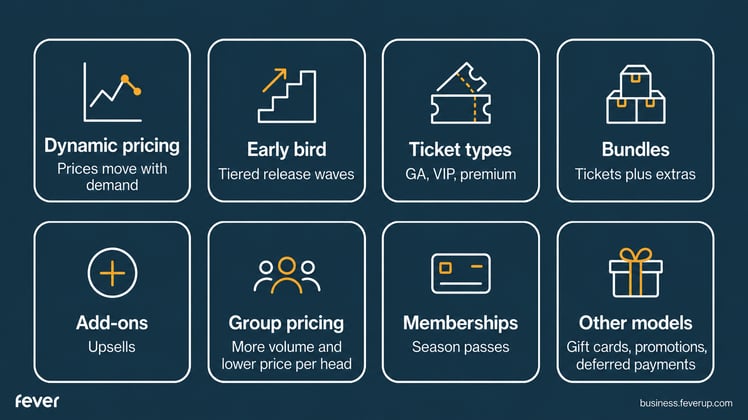
Most events combine several of these models rather than relying on just one.
Dynamic pricing
With dynamic pricing, ticket prices respond to demand. When sales accelerate, prices rise. When they slow down, prices can ease to keep tickets moving.
Dynamic pricing isn’t all-or-nothing. Think of it as a ladder, where you choose how much control to keep:
- Business rules (you decide): you define the logic and the parameters, such as occupancy, tickets sold, days to the event, or weather, and prices change only when those conditions are met. Full control, no model involved.
- Hybrid (the system recommends, you decide): forecast models suggest price changes guided by your business rules, and nothing goes live until you approve it.
- Fully automated (you set the limits): forecast models optimize prices continuously and apply changes automatically, always within the minimum and maximum prices you set.
The right level depends on your inventory and your appetite for automation, not on the size of your event. Most organizers start with business rules and move up once they’ve seen how prices respond to demand.
Early bird pricing or tiered release
Instead of opening all tickets at one price, release them in phases that build momentum:
- Waitlist: announce the event before tickets go on sale and let people sign up. You capture high-intent buyers and get an early read on demand.
- Presale: give your waitlist exclusive early access to the first price tiers for a short window before the public sale.
- General sale: open tickets to everyone at the standard price.
- Last chance: as dates fill up, remaining inventory moves to higher price tiers.
Time each price change to a key moment in your marketing campaign, so the news gives buyers a reason to act before the price goes up. For a music festival, that could be the headliner announcement or the full lineup reveal. For a show or exhibition, it could be the first reviews, a new date added, or the final weeks of the run.
Early phases reward fast decisions and bring in cash flow while you’re still promoting. Later phases capture buyers who are willing to pay more as the date approaches. And the size and conversion of your waitlist tell you how hard you can push prices before general sale opens.
Ticket type offerings
Offer more than one kind of ticket so each buyer finds the right fit: general admission or reserved seating, skip-the-line, VIP, or a premium experience. Clear differences between types make it easy to understand what each price buys.
Bundles and packs
Package tickets with other items, such as food and drink, merchandise, or multi-event packs. Bundles raise the average order value and give buyers a sense of savings, while you control which items you discount.
Add-ons and other upsells
Add-ons let attendees personalize their experience after choosing a ticket: parking, fast-track entry, food and drink, merchandise, meet-and-greets, or upgraded seating.
Keep in mind: the key is not to put the first sale at risk. Keep the initial purchase simple so as many buyers as possible complete it, then build up their spend over time. Each moment in the buyer journey is a new chance to offer something extra:
- During checkout: suggest one or two relevant extras next to the ticket, without adding steps that slow the purchase down.
- After purchase: follow up in the confirmation email or ticket page with upgrades the buyer may have skipped.
- Before the event: send cross-sell messages in the days leading up to the date, such as parking, merchandise, or food and drink packs.
- On-site: sell upgrades and extras at the box office or entrance for attendees who decide on the day.
This way you maximize conversion on the ticket itself and grow average spend per attendee across the whole journey.

Group pricing
Discounts for group tickets encourage attendees to bring friends, colleagues, or family. You lower the price per head, but you fill more seats and tap into new audiences through word of mouth.
Memberships / season passes
For recurring events, a membership or season pass secures revenue upfront and builds loyalty. Members commit early, attend more often, and tend to spend more on-site.
Other pricing models (gift cards, donations, deferred payments)
A few additional options can widen your reach:
- Gift cards let people buy your event as a present, bringing in new attendees.
- Donations or pay-what-you-want work well for community and charity events.
- Deferred payments let buyers split the cost over time, which lowers the barrier for higher-priced tickets.
Psychological ticket pricing strategies
Beyond the numbers, how you present a price shapes how people respond to it. These tactics work with human behavior rather than against it.
Price anchoring
People judge a price by what they see next to it. Use that to your advantage:
- Use a premium option as an anchor. A VIP ticket at $150 makes a $60 general admission ticket look like good value, even for buyers who never considered VIP. Just make sure each step up is easy to justify, so the extra benefit feels worth the extra cost.
- Add a middle option. When buyers see three choices, many pick the one in the middle because it feels like the safe, balanced choice. A standard ticket between general admission and VIP can become your best-seller, so price and design it as the option you most want to sell.
- Show the original price. When you run a presale or promotion, displaying the standard price crossed out next to the discounted one makes the saving concrete and encourages faster decisions.
Create urgency and scarcity where buyers decide
Urgency is what turns interest into a purchase, and the best place to build it is the ticket listing itself. Simple signals like tags (“Selling fast,” “Almost sold out”), a “last X tickets” indicator, and a countdown to the end of a sales phase or the event date show buyers that availability is limited and the moment to act is now.
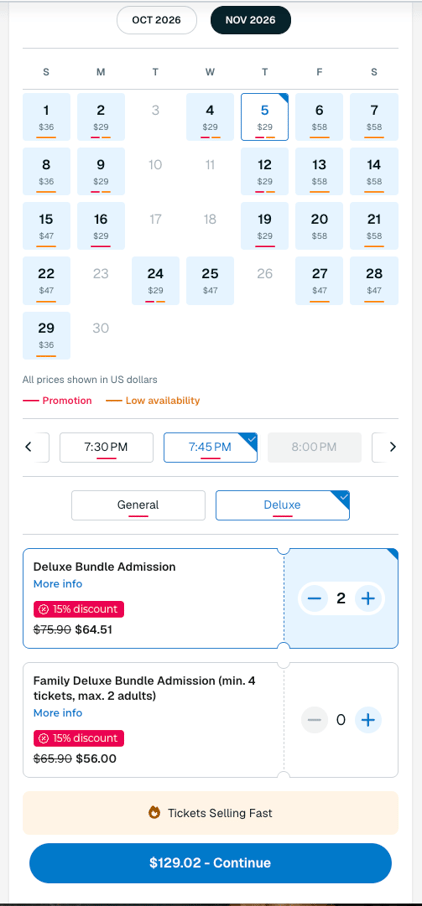 "Promotion," "Low availability," and "Tickets selling fast": urgency tactics as seen in Fever's ticket selector.
But the listing shouldn’t be the only place it shows up. Automated CRM flows carry that urgency to people who showed interest but haven’t bought yet, through abandoned cart reminders, low-stock alerts to waitlist subscribers, and last-chance emails before a price tier closes.
Keep the messaging honest and tie every signal to real inventory and real deadlines, so urgency builds trust instead of eroding it.
Exclusivity
Limited-access tiers, members-only releases, and invite-only offers make a ticket feel more valuable, which supports a higher price. Buyers stop weighing cost against benefit and see the ticket as access to something others can’t get. Three effects make this work:
- Scarcity bias: people value what’s harder to get, so limited availability raises perceived worth.
- Social identity: being part of a select group, like members or early-access fans, gives buyers a sense of status and belonging.
- Quality signaling: buyers often assume that the harder something is to access, or the more it costs, the better the experience will be.
Segmented promo codes
Instead of discounting for everyone, create codes for specific segments, such as students, past attendees, newsletter subscribers, or content creators. You reward the audiences you want to reach, track which channels convert, and protect your full-price sales.
How Fever can help you build your event pricing strategy
Pricing works best when there is demand behind it and data to guide it. Fever brings both through four strategic levers:
- Distribution: access to millions of high-intent users actively looking for things to do, so your pricing strategy has an audience to work on from day one.
- Pricing tools: pricing tiers, business rules, and dynamic pricing, plus waitlists, presales, bundles, add-ons, group pricing, memberships, and promo codes, all in one platform.
- Marketing: campaigns planned alongside your pricing, so price changes and promotion push in the same direction.
- Data and insights: real-time reporting on sales velocity, conversion, and revenue per attendee to help you adjust prices with confidence.
This approach is backed by experience at scale. Fever has managed ticketing and demand generation for more than 200,000 experiences in over 55 countries, and partners such as Formula 1, Rock in Rio, FC Barcelona, and the National Museum of the Royal Navy rely on Fever to sell and optimize their tickets.
If you want to improve the way you price, sell, and optimize your tickets, explore our ticketing revenue optimization solutions or talk to our team about the right pricing approach for your event.
Frequently asked questions about event ticket pricing strategies
Should I include fees in my ticket price?
Not necessarily. In some markets buyers are used to seeing booking fees, while in others they expect a single all-in price. In the U.S., if you charge mandatory fees on your live event tickets, the total price including those fees must be shown whenever a price is displayed, not just at checkout.
What are some effective ticket pricing strategies?
Popular strategies include dynamic pricing, early bird discounts, tiered ticket offerings, group pricing, and memberships or season passes. Bundles and add-ons can also increase revenue per attendee, while segmented promotional codes help attract specific audiences.
The most effective approach often combines several strategies based on your event's goals and audience.
How to price tickets for an event?
Start by defining your event's goals, researching your audience's willingness to pay, and comparing prices for similar events. Calculate your break-even point using your fixed costs, variable costs, and expected ticket sales. Then choose a pricing model that balances profitability and attendance, accounting for demand, venue capacity, seasonality, and ticketing fees.
How can you optimize event ticket pricing based on demand?
Monitor historical sales, ticket sales velocity, remaining inventory, and seasonal trends to understand how demand changes. With dynamic pricing, you can raise prices when demand increases and lower them during slower periods.
For events with multiple dates or time slots, adjust prices based on their individual demand patterns.
What should you do if your event tickets aren't selling as expected?
Before changing prices, find out where in the funnel you’re losing buyers:
- Upper funnel: check your campaign performance. Low reach signals a problem with targeting, channels, or budget, and high reach with few clicks usually means your creatives or messaging aren’t connecting.
- Lower funnel: if people visit your event page but don’t buy, review your conversion rate, your content (images, description, reviews shown), and your pricing against similar events.
You can also look at event quality, that is, attendee reviews and ratings. Poor feedback from earlier dates can hold back sales no matter how you price.
Related articles
All articles →
How event dynamic pricing is the proven strategy for tickets in 2027
Learn how event dynamic pricing works for live event tickets, what data drives it, and how organizers use it t…
Event ticketing platforms: 6 capabilities to evaluate before switching
Comparing event ticketing platforms? See which capabilities actually move revenue, from dynamic pricing to rea…